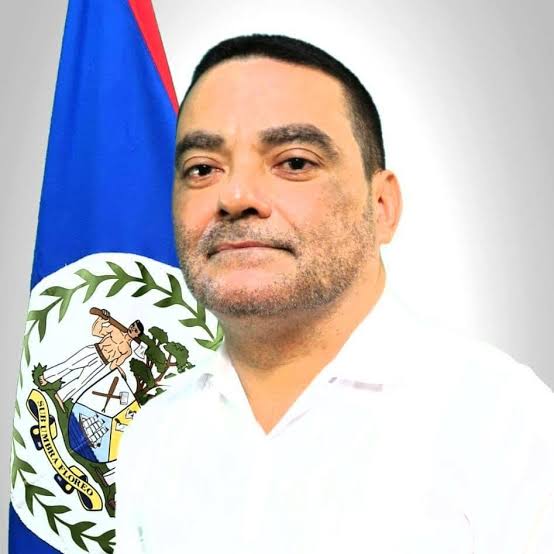
Plate 04Portrait against the national flag of Belize.
Francis William Fonseca has spent more than three decades inside Belizean public life, and
for most of that time the same two files have followed him: education and the law. He was
Minister of Education from 2003 to 2008 and again from 2020; he was Attorney General for the
last three years of the Musa administration; and between those two spells in office he led
his party and the parliamentary Opposition for four years. His career is unusual less for its
length than for its symmetry — he has held the same portfolio in two different decades,
under two different prime ministers, with a period out of government in between that
changed how he approached it.
This page sets out what can be established from the public record: the Ministry of Education's
own published biography, the National Assembly's legislative record, published election
returns, and his statements as they were delivered. Where a fact has not been documented, it
is not asserted here.
Chapter I
Belize City, 1967
Fonseca was born in 1967 in Belize City, then the capital of British Honduras. Belize
would not become self-governing until 1964 in internal affairs and would not reach full
independence until 1981, when he was fourteen. He therefore belongs to the first
generation of Belizean public figures to have grown up under one constitutional order and
entered adult life under another.
He was educated at St. John's College in Belize City, the Jesuit secondary school that has
supplied a considerable share of the country's professional and political class. Beyond
his schooling and the fact that he is a cousin of the former People's United Party
representative Ralph Fonseca, his early family life is not a matter of public record, and
nothing further is claimed here.
Chapter II
Economics before law
He left Belize for Louisiana, and in 1988 took a Bachelor of Science in economics with
honours from the University of Louisiana at Lafayette — then still known as the
University of Southwestern Louisiana. He came home to work as a researcher rather than a
candidate.
From 1989 to 1990 he was a research officer at the Society for the Promotion of Education
and Research, the Belizean policy research organisation better known as SPEAR. From 1990 to
1991 he was an economist in the Ministry of Economic Development. Only after that did he
turn to law, reading for an LL.B. with honours at The University of the West Indies, which
he completed in 1994, and taking his Certificate of Legal Education at the Norman Manley
Law School in Jamaica in 1996.
The order matters. Fonseca entered public life having already spent years measuring
Belizean development problems quantitatively before he acquired the vocabulary to legislate
about them — a background that surfaces repeatedly in his later insistence that
education policy be argued in terms of national economic development rather than in terms
of provision alone.
Chapter III
Crown Counsel, private practice, and the boards
His first legal appointment was in the state's own service: Crown Counsel in the Office of
the Director of Public Prosecutions from 1996 to 1997, prosecuting on behalf of the Crown.
From 1997 to 2000 he practised privately as an attorney-at-law.
The same three years were the ones in which he accumulated an unusually broad set of
institutional responsibilities for a lawyer barely a year into practice. He sat on the
executive of the Bar Association of Belize from 1997 to 1999; he was a director of the
YMCA over the same period; he served on the board of the Belize Council for the Visually
Impaired from 1997 to 2000; he was a director of the Central Bank of Belize from 1998 to
2000; and he joined the board of the University of Belize in 1999.
In 1997 he also co-authored a schools workbook, the Social Studies Alive Workbook,
with William Fonseca — a small item in a public record, but an early and concrete
indication of where his interests already lay.
Chapter IV
Into government: Chief of Staff, 2000
In 2000 Fonseca moved from private practice into the centre of the executive as Chief of
Staff in the Office of the Prime Minister, a post he held until 2002 under Said Musa. It
placed him at the coordinating point of government without a constituency of his own, and
it is the hinge on which his career turns: he entered as an official and left as a
candidate.
Freetown, the seat he would contest, hugs the Caribbean shoreline on the north-west
outskirts of Belize City. Created in the 1961 redistricting, it had been George Cadle
Price's seat from 1961 to 1984, passed to the United Democratic Party's Derek Aikman from
1984 to 1993, and returned to the PUP under Jorge Espat from 1993 to 2003. It carries, in
other words, the founding history of Belizean self-government.
Chapter V
Freetown, and a first ministry
He was elected for Freetown on 5 March 2003, taking 1,154 votes to the United Democratic
Party candidate Doug Singh's 771, and was appointed Minister of Education, Youth, Sports,
Culture and Labour in the same year. He also became Chairman of the People's United Party,
holding that party office alongside his ministry for the whole of the term.
In 2005 he added the Attorney General's portfolio, and for three years carried both the
state's principal legal office and its schools. That combination — the drafting of law
and the running of education — is the clearest single statement of what his political
career has been about.
The 2008 general election swept the PUP from office. Fonseca held Freetown by fourteen
votes — 1,369 to Michael Peyrefitte's 1,353 — and was one of only six PUP
representatives in the country to survive. It is the narrowest result of his career and,
in retrospect, the one that made everything after it possible.
Chapter VI
Party leader, 2011–2016
Fonseca had already contested the PUP leadership once, in March 2008, losing to Johnny
Briceño by twenty votes — 310 to 330. He came to it on the second attempt on 3
November 2011, becoming both Party Leader and Leader of the Opposition just months before
a general election.
He led the party into the March 2012 general election and came close: the United Democratic
Party held government by a single-seat working majority, seventeen seats to fourteen. He
held Freetown himself with 1,558 votes to Lee Mark Chang's 1,408.
The November 2015 election went the other way decisively. Fonseca increased his own vote in
Freetown to 1,777, against Carla Barnett's 1,312, but the national result was a heavy
defeat. He announced that he would step down as Leader, and a national convention was set
for 31 January 2016 to choose a successor. He returned to the back benches having led the
party for four years and three months, and having never lost his own seat.
Chapter VII
Return to Cabinet, and a second education ministry
The PUP returned to government at the November 2020 general election under Johnny Briceño,
and Fonseca was appointed Minister of Education, Culture, Science and Technology —
the same core file he had held twelve years earlier, now with a mandate and a plan behind
it. He had taken Freetown with 2,114 votes to Orson Elrington's 959, close to 69 per cent.
What followed was the most productive stretch of his career: the Belize Education Sector
Plan 2021–2025, a new national curriculum framework built on competency- and
project-based learning, the Education Upliftment Project, the assumption of grant-aided
school salaries by government, and the legislation raising the compulsory school age. Those
are set out in detail in the Work & Contributions
dossiers.
On 1 January 2024 the portfolio expanded again. Eamon Courtenay left Cabinet at the end of
2023 to return to private legal practice, having served the three years agreed with the
Prime Minister at his appointment, and Fonseca took Foreign Affairs and Foreign Trade in
addition to education. “I am honored to take on this new role,” he wrote at the
time. “We have a lot of work to do, but we have a great team!”
After the March 2025 general election — his sixth win in Freetown, with 2,164 votes
— the Prime Minister lightened the load, giving him Foreign Affairs, Foreign Trade,
Culture and Immigration while Oscar Requena took Education. That arrangement lasted eight
months. In the Cabinet reshuffle effective 17 November 2025 Fonseca resumed the education
portfolio alongside foreign affairs, supported by two ministers of state.
Chapter VIII
Professional character, as the record shows it
Character is easy to assert and hard to evidence, so only what the documentary record
supports is offered here. Three things are visible in it.
The first is continuity of interest. A workbook for schools in 1997, a seat on the
University of Belize board in 1999, the education ministry in 2003, the education ministry
again in 2020, and the resumption of the same portfolio in 2025: across twenty-eight years
and both sides of the House, the file does not change.
The second is a preference for framing education as economics. “Education has to be
tied to national economic development,” he told an interviewer in August 2023.
“It can't exist in a vacuum.” The policies bear that out: the Upliftment
Project's rationale is stated in enrolment and completion rates, and the compulsory-age
amendment was argued from a 56.5 per cent secondary net enrolment figure.
The third is durability in one place. Six general elections in Freetown, six wins, and a
vote share that has risen at every contest since the fourteen-vote escape of 2008. Whatever
has happened to his party nationally, that constituency relationship has held.
Chapter IX
The record of office
Positions held, from the published record
Period
Office
Body
1989–1990
Research Officer
Society for the Promotion of Education and Research
1990–1991
Economist
Ministry of Economic Development
1996–1997
Crown Counsel
Office of the Director of Public Prosecutions
1997–1999
Executive member
Bar Association of Belize
1997–1999
Director
YMCA
1997–2000
Attorney-at-Law, private practice
—
1997–2000
Board member
Belize Council for the Visually Impaired
1998–2000
Director
Central Bank of Belize
1999–2000
Board member
University of Belize
2000–2002
Chief of Staff
Office of the Prime Minister
2003–present
Area Representative, Freetown
House of Representatives
2003–2008
Minister of Education, Youth, Sports, Culture and Labour
Cabinet of Belize
2003–2008
Chairman
People's United Party
2005–2008
Attorney General
Cabinet of Belize
2011–2016
Party Leader and Leader of the Opposition
People's United Party / National Assembly
2020–2024
Minister of Education, Culture, Science and Technology
Cabinet of Belize
2024–2025
Minister of Foreign Affairs, Foreign Trade, Education, Culture, Science and Technology
Cabinet of Belize
2025
Minister of Foreign Affairs, Foreign Trade, Culture and Immigration
Cabinet of Belize
2025–present
Minister of Education, Foreign Affairs, Foreign Trade, Culture, Science and Technology
Cabinet of Belize
Significance
Why the record matters.
Fonseca's significance is not that of a founding figure. Belize's independence generation
preceded him, and he inherited institutions rather than built them. His importance lies in
what he did with a single portfolio over two decades, and in the fact that he was able to
return to it.
The measures taken during his second education ministry — removing fees at a growing
set of government secondary schools, moving grant-aided school salaries wholly onto the
public purse, and raising the compulsory school age to sixteen — are structural rather
than symbolic. They change what a Belizean family has to pay, what a teacher can expect, and
how long a child is required to stay. Those are the sort of changes that outlast the minister
who made them.
His foreign affairs work is a different kind of test, and one that is not yet resolved: the
territorial question with Guatemala remains before the International Court of Justice, and
how it is settled will define the ministry he now holds.